
Al, Higher Ed Policy, and the Future of International Student Recruitment

 Apple Podcasts
 Spotify
 Castro
 RSS Feed
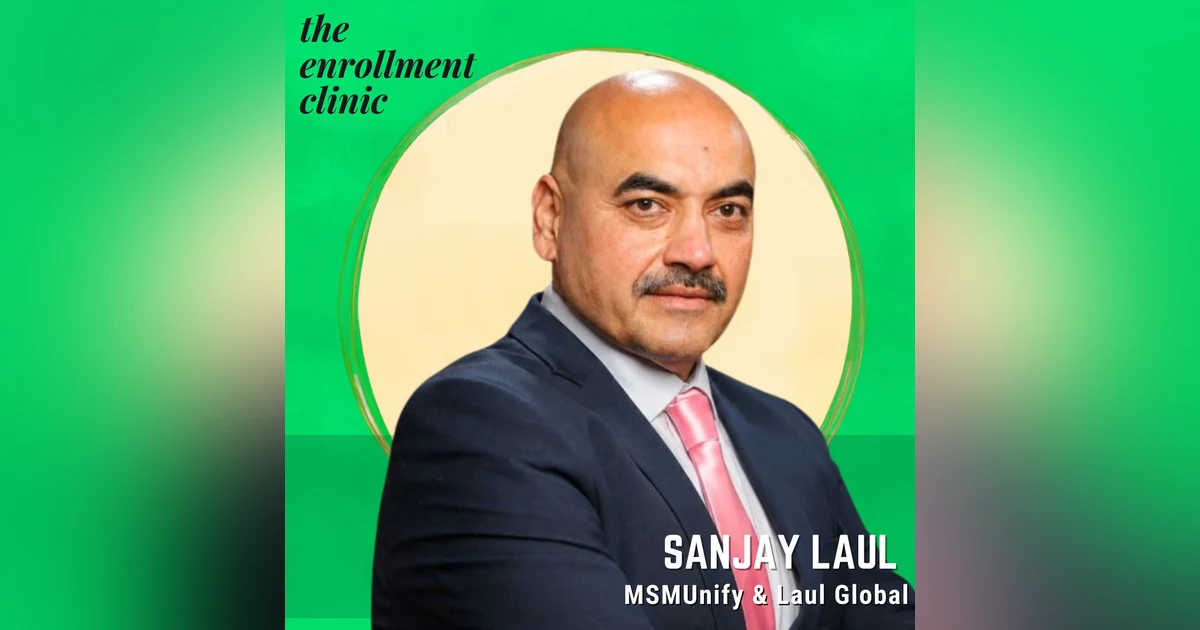
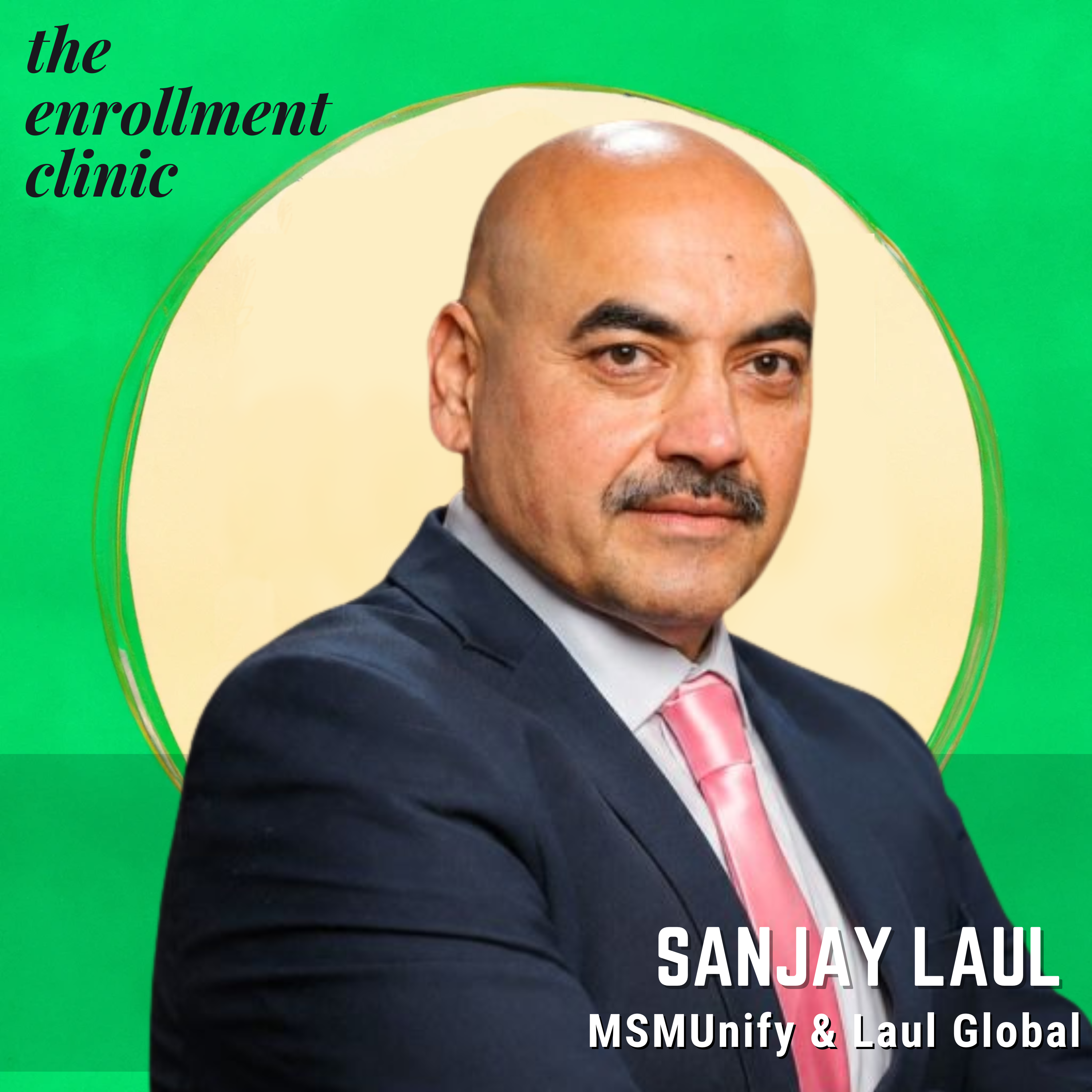
 Sanjay Laul, founder of MSM Unify and Laul Global, and one of the most influential builders in student mobility today sits down with Gjergj Dollani, host of The Enrollment Clinic to discuss his views on Higher Education.
His path into higher ed wasn't a straight line. It was fraught with challenges, set backs and even failure. One observation in the streets of Delhi eventually grew into a global education company now operating across 50+ countries.
This conversation goes past the usual talking points into where the industry is actually headed.
What we cover:
→ Why Sanjay sees AI as the biggest shift in higher ed since the internet, and why every new MSM hire has to pass an AI capability test before they start
→ MSM Aventra, the integrated CRM, SIS, and LMS platform built to run the full student lifecycle
→ MSM Campus OS, the "education process outsourcing" model already deployed across 15 institutions
→ The real story behind the Canada and US policy shifts, and why Sanjay is still betting on the US to stay the #1 destination
→ How China is quietly pulling ahead as the world's top country in student mobility, both sending and receiving
→ The growth markets most enrollment leaders are sleeping on: Southern Europe and all 54 countries across Africa
→ The uncomfortable truth Sanjay says the sector still refuses to face...
Enrollment, recruitment, higher ed leadership, this one's worth your time.
speaker-1: Welcome to the most recent episode of the Enrollment Clinic. This is an episode that it's been months in the making. So I'm really happy that that we're here today. My guest today is Mr. Sanjay Laul. He is the founder of MSM Unify and Dawood Global. Welcome to the Enrollment Clinic.
speaker-0: Thanks thanks, Georji, for having me here and a very good morning to you and to our guests.
speaker-1: Pleasure. And and is Sanjay, this is an interview that I've been going after for for a long time. And and the reason why I've really sought this after is because you are not only the founder of one of the largest higher education, international higher education organizations out there, but also you are vocal in in in policy, international education policy, domestic education policy. You're vocal about technology. in higher education. So it's going to be a a a great conversation that I think will be very valuable to a lot of the listeners. The first question that I wanted to start with is could you just give us a a very quick background of how you started and how you landed in higher ed?
speaker-0: Yeah, so thanks Shaji again and about my journey it started from Lucknow which is four hundred twenty-five kilometers from New Delhi, north of New Delhi and that's where I'm born and raised up. not a very global exposure in the beginning. Dropped out of engineering in eighteen months and then I've Completed later on my graduation as a distance learning. But overall, my journey initially was full of turbulence. 10 years, one field business after the other. One thing I never wanted to do was I never wanted to get into a job. And that was very clear when I was in my school days. I don't know where it came in my mind. But I always wanted to be into business, to be an entrepreneur. And Being a first generation entrepreneur, not much guidance. in my early years and at least ten years of my career, I struggled a lot. started with a clothing store in front of my house and failed in a couple of years, then failed in other businesses. So it took a while for me because of less guidance, less exposure. And then in 2000, in around 2000, I came to Delhi and I wanted to immigrate to Canada. Started going to the immigration consultants and I saw a big lineup with immigration consultants. You would have to wait three to four hours with the immigration consultants in Delhi. And then I wasn't eligible to immigrate to Canada that time. And I felt, this is a good business, so much of potential and so much of weight for the people who want to immigrate. And with my cousins and friends, I entered into this. business. So that was a start. Then of course as businesses start four partners started together one after the other left because it was taking time to bring in revenues. And in the fourth or fifth month I got three thousand rupees as a client came for visitor Vita consulting and that was a start. Three thousand rupees Indian rupees in Delhi and sorry
speaker-1: Sorry. Yeah. Sorry. Just what would be that equivalent in say Canadian or US dollars?
speaker-0: So now a three thousand rupees is thirty US dollars. So
speaker-1: Right?
speaker-0: And that was the start of of my revenues into immigration and then in less than a year I had twenty one offices for immigration consulting and then the Canadian rules changed in two thousand three and permanent residency rules the point skilled immigr skilled migration points changed from sixty seven to seventy three, that means now skilled migration won't be so attractive to the Indian audience. And then I ventured into education consulting. So from two thousand three until today. And that's the love of global education. I am into global education not because of business, not because of money. I think that's where the passion is and love doing what I do.
speaker-1: The storyline I think for your story that you shared today is having that business mentality, having those failed businesses is a great education, right? It's it's a university in and of itself. And I think that's once you see an opportunity and you see there's an outcome there, it's it's easy to jump in. Now that you are in in higher ed, now that you've kind of seen the industry, you've been in the industry for over twenty years now, and you've seen it at various levels, right? Like from From working with agents all the way to villages, anywhere in the world, right? To running universities, owning universities, starting universities. What is one thing about higher ed as a business that it was new to you from running all these other businesses? What what do you think would be one big difference between higher ed and and the traditional businesses that are out there?
speaker-0: So dealing with the institutions, one thing I felt like other businesses, they're not so hierarchy driven. Here the businesses, education educational institutions, president, vice chancellor, then the vice president, provost, then the dean, then directors. Very hierarchy driven. and people have a mindset that okay, now you have to deal with a director, you have to deal with a VP. So Not that other businesses don't have those hierarchies. I think here in most of the public institutions, we are still way, way behind when it comes to the engagement with the stakeholders at different levels.
speaker-1: When when you say we, do you mean you as as an institution or or that as a partner to universities or universities in general?
speaker-0: so now sector is divided into private and public. I think when it comes to private, private is more forthcoming and is changing and is becoming more like a corporate. Public still is a long way to go. Not that all institutions, I would say all public institutions are not so conventional. Some have become forward looking, but a majority of the public institutions there's a long, long way to go in terms of engagement with the stakeholders at different levels.
speaker-1: Yeah, yeah, agree. And and and now I think they're getting a lot of pressure because you have the domestic enrollment cliff, you have the international student cliff in and of itself. You now have in the US, there's a program that was financing grad students, called Grad Plus. Now that's that's gone. So so there's a a mini cliff, domestic cliff also for graduate students as well. And I I saw one prediction there that probably about forty percent of of current universities, you know, public and private will probably not be around in the next 25 years. And again, it's hard to predict the future. But now with all of these technological shifts, and I know that you follow, you know, these a lot, what do you think the industry is going to look like? And again, it's it's very hard to predict the future, but I'd love to hear your thoughts on where do you see the industry in the next five to ten years?
speaker-0: So, as like all other industries and even the world, if you see, is changing. Two decades before we had internet that came in and that changed the world, and I think this is now the AI that is going to change the world, how we are going to live, how we are going to act and react. So, like all other industries, education, how it is delivered, whether in schools or post-secondary or higher education, this will all change. The next few years. I would say the next couple of years, I see that institutions, higher education that is very fragmented department-wise. Now that is going to change, and that has already started changing. So it's going to be an integrated, integrated student life cycle model. So all whether it is personalized counseling, whether it is admissions, whether it is learning support, whether it is retention, and even career guidance. the outcomes. Everything would be integrated and departments won't be running in silos. That's the biggest change that we will see.
speaker-1: And and is that how are you preparing for that at MS Unify?
speaker-0: At MSM Unify, you see we are already investing a lot in technology and AI. And when it comes to the platform, I'll tell you we have recently launched MSM Aventra, with which is a CRM student information system and learning management system, all integrated into one. And those who have started using it, wherever we have given demos, the industry. people feel that this is one of the best platforms the way it is integrated for the whole student journey. That's where we are investing. We are investing in tools. We are investing in solutions and that's the next era that we want.
speaker-1: Yeah. I'm I'm familiar with MSM. I mean I've have have worked with with MSM as a partner school for for a bit now when when in a in a previous life as well. For a lot of the listeners that do not know much about MSM, what MSM is and does.
speaker-0: Yeah, and thanks Georji for that. So you see i I'll give you with a background a little bit and then what how we have transformed and what we are today. So when we started in twelve years ago, it was primarily a global student mobility company and very focused on in-country offices. So we started with one Canadian institution in northern BC, Northern Lights College. We got the second client as Selka College. And we provided support to them in terms of student recruitment as their country offices in India India subcontinent and brand and marketing and liaison with Canadian High Commission, working with the agents, education agents, due diligence of education agents, application management, and so on. From there, for the next few years, we continue to provide these services as can in-country offices to. More than fifty institutions around the world and most of the most of our clients would be public institutions. In the last three, four years, because of the cash positive we have been in the business, we started investing in diversification within the education sector. So at MSM Unify now we have global student university, global student mobility as one division, which has in-country offices and which has A platform where we have around 1500 campuses and students and agents can choose the institution. They get personal guidance. A lot of I technology has been integrated into it for students and agents. So that's one platform. And then second, we have ventured into MSM Campus OS, which is our education process outsourcing model where we operate more as an operating system. Campus OS is Campus OS. OS means operating system. Apart from student recruitment, whether it is brand and marketing, whether it is admissions, whether it is registrar office, chart, finance and accounts, we support all the functions of the institution and we let the institution focus on education and education delivery while we strengthen their backbone of operation. So that's the second division and third is our MSM grad, which is again under MSM Unify. SM grad is into online programs with a certificate, diplomas and degree online global.
speaker-1: And and is MSM grad is a is an OPM meaning do you create your own programs or you promote programs from schools?
speaker-0: both. So we have recently signed up with Davis University in Ohio as MSN Management. it's a nine months management program, and students can take from anywhere in the world. they don't need to come to the US. And it's delivered partly by the institution and partly by us, same as with Wolf University in Malta. And we are delivering MSN Cybersecurity as a co-credential with MSM grad. So MSM grad infrastructure is strong learning management system law and very strong content delivery. That's where we have invested a lot of resources now. And whether it is bachelor's, whether it is master's or doctorate or certificate level programs, we have an infrastructure now to deliver and compete with the best of the universities in the world.
speaker-1: Mm, that's great. And how are you 'cause I I I you're a a very big proponent of of the technology and AI, how are you pushing your team to incorporate AI and these new technologies more into the day-to-day life of the programs that you provide?
speaker-0: L like any other company, I think there's always a resistance from the teams and it took me a couple of months to find the ambassadors within the organization and early adopters. We identified those and I is being pushed at all levels every day and we set up goals, monthly goals as well of where we have to go with AI at every department. and one thing that has helped us is one that we made sure that our senior leaders adopt AI first. Once they adopt, they understand the efficiency it brings, the power that it brings to their labs, then it becomes easy. And then and that's what happened. So that's one part. And second is because we are growing and we are hiring a lot of senior executives, we are diversifying. So one thing that we have changed is that at every level of hiring an AI capability test has to be taken up by the prospective candidates.
speaker-1: Hmm.
speaker-0: And that means we are making sure that we are an AI native company rather than lagging behind and trying to follow the industry.
speaker-1: This this segues to an important topic that I wanted to cover with you. I know you're very vocal about higher ed policy. you currently reside in in Canada. You do a lot of work there, you do a lot of work in the US as well. And specifically in the last year, year and a half, both countries have been on the news for their various changes to international student policy, domestic student policies, specifically Canada for for a while. Stopped all the visas for for Indian students. The US obviously has been going through their entire issues. They just released a a new. Policy, new policy rules very recently, a few weeks ago, that made it really more much more stringent for international students to come in, select the universities they want. They the commitment now from an international student standpoint has to be very, very high to be able to attend American universities here. Tell me a little bit about what your thoughts are on these changes and how do you think? these countr what how they will affect these countries in in the long term.
speaker-0: So before I start with the real answer of your question, I would say that very important we have to understand. Governments have a legitimate responsibility to protect quality, housing, immigration integrity and labor market. And government makes a decision based on all what they have to take care of and somehow a global education, international education industry gets impacted. So that's what we have to understand how government makes makes decisions. In case of Canada, if you see the government needed immigration, fast immigration, and it opened the funnels in 2012-13 for international education. when it opened the funnels, there were a lot of institutions that did things right. Some institutions that did not understand the funnel is open and they just took it as more of revenues. And that's where it goes wrong. When the government opens the funnel, government may be wrong. There was not much strong governance over it. And it's a learning process overall. Same as if you look at the US, US is making decisions based on what's right for the country and what's not. Right for the country and global education or international education sector is getting impacted negatively because of it. And but overall I have to say, whether it is particularly for the US, US will still, I feel that US will continue to remain the number one destination when it comes to international education. Now, whether international education students are coming to the US or US universities are going outside. Look at the quality of education, the research funding. Which other countries can match that of the
speaker-1: So w what's your thought on China? So there are a few Chinese universities now that are clawing their way up to the top ranked universities in Times Higher Ed list or or some of these ranking institutions. What's your what's your thought on that?
speaker-0: So China as as a country, you see, they are they are making an impact, leaps and bounds all over the world. If you look at Chinese goods, can a country, can any country really survive without Chinese goods? Whichever way those come. So they became like a if you look at China, they became like a manufacturing hub, but now they are not a manufacturing hub anymore and they are making an impact in technology, in AI and In every other sector. And that's a lot of that to do is with the way they have transformed their education. So whether it is Chinese universities or Chinese high schools, I think that's where the products are coming from and that's where the real impact has come. So what they started ten years ago or twenty years ago into education and that's impacting positively to their country.
speaker-1: And and do you think at do you expect China at some point to be as big or of a of a international student to be a market where students will go to attend universities as Western Europe, Australia, Canada is and and the US?
speaker-0: So if I'm not wrong, if we count as if you look at global education, receiving students plus sending students together, China is already number one. So in terms of global student mobility they have already made a huge impact and ch China would continue to remain one of the co-countries in international education, whether it is sending students or receiving students.
speaker-1: That's that's a that's a very good point and and I I was in Morocco for for some recruitment events there and I was very surprised to know that China is actually the number one country, destination country for Moroccan students in terms of education. The US was not ranked very high in that sense, so so China and France were the two top destinations and and even the people that I met there had actually graduated from Chinese university so that was that was new to me there. So I I can definitely concur the trend that you're you're talking about. Now if you are talking to say a VPO of enrollment at at a US or Canadian university and then they're going through they're seeing all these changes, what would what would you say to them in terms of what their outlook, what sh they should be expecting in the next five years?
speaker-0: So one thing my statement would always remain same. International demand is not going away. Global demand for quality education will continue to rise. And that's one part. And now when it comes to VP of enrollments, like all other positions within the institutions, the way this position has to work is becoming a little different because the industry has changed. The way we used to recruit students before in any of the institutions, now it is not going to work. so we have to look at if the policies have changed in let's say the US policies have changed and the US institution VP of enrollment continues to do the same thing that he or she was doing five years or ten years ago won't work. So one is not to not to bank upon one program, one source country and not to bank on just bringing in international students. I think very important is Trans-national education will continue to play a big role and will continue to increase enrollments for those institutions that are going to go outside. So that means we are not talking of just on-campus programs anymore. Hybrid and online will play a major, major role. And if you look at I should have a figure somewhere for you, digital education market is at 44.6 billion and The biggest part is that it would continue to grow at thirty-one point five percent CAGR through twenty thirty. I think th these are the important figures because the lot of research says that it is decreasing, at least the online degree market in the US is decreasing. But globally it's increasing. That's where the upside is, and VP of enrollments. In the US institutions have to look where the growth is, where the greener pastures is and focus there too.
speaker-1: And and speaking of greener pastures, so you you you focus on on a lot of different countries, right? you have country managers. What from a geographical perspective, what do you think is is an area that excites you in terms of where growth will be coming from? I was talking to a couple of people at different universities in the Balkans and now they're interested, very, very interested in opening up to international students, which was something interesting to me, but I'd love to Hear your perspective on that.
speaker-0: Yeah, so it's not just at Balkans but look at southern Europe or all over Europe. I think these countries have strong, strong potential and first the countries were not open to international students so much and they are opening up at the right time when US, when Canada and when Australia and when UK, these big four countries are being a little restrictive, these countries are opening up at a time That's very right for them. So we will see a lot of new destinations and we are already seeing these destinations emerging. The numbers will never be, we have to understand these destinations, European destinations won't have the numbers that these big four have got or they won't be able to accommodate. Now these countries will have less numbers, maybe twenty thousand, maybe thirty thousand, maybe forty thousand overall. But look at the collective if twenty new destinations are able to bring in fifty thousand more students on average, what a number of that.
speaker-1: Yeah, yeah. And what's your what's your thought on on Africa, not just as a as a source of international students, but even within the countries there? Are there countries that you think are going to be big into drawing students from countries around them?
speaker-0: That's already happening a bit. So, like if you look at South Africa, it's drawing students from other parts of Africa. So those who will be a little more developed than the other African nations, we have seen and we will now see a little more student mobility from one country, one African country to another African country. We'll see that mobility more. But If you look at overall, African students should be f the fifty-four countries should be counted as one big market and they will remain big source countries for other destination countries in Europe and North America.
speaker-1: As we're approaching the the end of the episode I wanted to spend a little bit of time just talking about MSM Unifies platform. We had mentioned earlier Campus OS and and that was interesting to me because it it felt like and and I I like the thought of of an operating system for schools, right? With like a an interesting way of packaging all of the different products that you provide. Just can you give me a quick overview of Campus OS? What are some of the products in there and and with the universities that you're currently are working with? How are they using these products?
speaker-0: Yeah, so how this campus OS even came into existence, I would start from that. See, apart from MSM Unify, Laul Global runs a few institutions, f few private colleges in Canada and now have recently opened up a university in the US. That's our first foray into higher education in the US with Florida Coastal university. So that offers bachelor's, master's, and doctorate level programs in business management, information technology, and educational leadership. So while supporting these institutions overall, while building this infrastructure, whether it is LMS, student information system, or CRM, we found that we have over a period of years we have built quite a bit of strength within the group to manage institutions. And then Because of MSM Unify, when we were interacting with institutions, we could understand the pain points of the institution. That's how the idea of MSM Campus OS emerged. So it's more of an education process outsourcing model and which is supported by technology, which is supported by data and specialist operating teams. So we would have teams for digital marketing admissions, student support, student engagement, technology support. Analytics, finance, registrar, and compliance. So we have created more of a backbone of an institution where an institution can focus on education and education delivery. And we can help them manage everything, whether it is to improve the turnaround time for conversion for student support and bring And the best part is bringing the cost efficiency and a lot of management visibility.
speaker-1: And right now, what is there specific countries that you're focusing on with this service? Is there what's what's like the the product map, the go to market product map?
speaker-0: So we've already signed up around fifteen institutions and most of these institutions are signed up in India and a couple of institutions in Europe. And because this has started just three months ago, but we have got a head start with fifteen institutions, and we expect to sign up at least four or five institutions every month. So the teams and the technologies are being scaled up with that pace now.
speaker-1: Mm. And and for the US I would assume the the Florida Coastal University is using this model, right? This backbone.
speaker-0: Florida Coast University the backbone is the infrastructure of MSM Campus OS that has been created. For the US, we're looking at increasing our team strength in the US and then in the next few months I'm hopeful that we'll be supporting many US institutions with our MSM Campus OS.
speaker-1: And and what is, because that's a great segue to to my next question, what what would be what is the the the crux or of the discussion with say enrollment leaders in the US when you're proposing Campus OS?
speaker-0: So if you look at quite a bit of not-for-profit institutions in the US, they are facing financial challenges. They are facing declining enrollments. And MSM Campus OS is a great solution for them where they can bring their costs down. They have, let's say, not spent a lot on upgrading their technology. Campus OS becomes the right solution for them. And we are hearing a lot of positive feedback about MSM Campus OS. But it's just that in the US institutions decision making takes a little bit of time. Our models have to be well compliant with the equitation bodies, which they are completely now. that's where I am seeing very good potential for MSM campus.
speaker-1: Yeah. I I think one of the difficulties I'm sure for for these enrollment leaders is having to offload their their staff, right? The finance teams and and all of these other day to day people that are walking around campus and and in in a sense I think one of the one of the reasons why or one of the discussions on why university costs have gone up is because the amount of staff has tripled and and quadrupled so I I can see how there would be a lot of value here. Now I have one last question for you and it's a question that I that I ask a lot here. What is one thing in in our industry that we're not talking about or we're not talking enough about? The mean
speaker-0: Thing would be, I would say, student outcomes. Not that we are not talking about. You see, we are in the education sector, and if you look at there is no dearth of learned people or even ideas in the sector. So, in fact, we discuss in the sector, we discuss about everything. It's not that we don't discuss about these things. But the real question is whether we are walking the talk on student outcomes. Not completely. So that's where I think the industry has to do a lot. That student outcomes have to really meet the expectations of the student. They should be able to get into the job market or into entrepreneurship of
speaker-1: Awesome. Well thank you very much, Sanjay. This has been a pleasure and and and I'm sure we could have had this episode for for three, four hours and and and still continue to talk. So I'm hoping you know to have you back at at some point and and see what the progress is of some of the universities in Canada and and obviously Florida Coastal University as well.
speaker-0: Thanks, thanks Georji. It was great chatting with you and look forward to the next one as well.
speaker-1: Awesome. Thank you so much.
speaker-0: Okay, bye-bye.
Founder
SANJAY LAUL
Founder, MSM Unify
Sanjay Laul is the Founder and CEO of M Square Media (MSM), a Canada-based education and edtech company present in more than 20 countries. A first-generation entrepreneur, he founded MSM in 2012 around a single conviction: that higher education institutions and the students they were trying to reach — in India, across Africa, and elsewhere in the world — deserved a transparent, risk-free way of finding each other.
That idea has since grown into a global platform. Through student recruitment, a network of global and in-country offices, and pathway solutions, MSM today serves over 1,200 partner institutions worldwide and has supported more than 135,000 students since inception. The company is backed by a team of over 500 professionals, an extensive network of education agents and counsellors, and long-standing partnerships across the public and private sectors.
With more than two decades of operations and senior management experience, Sanjay specialises in strategic partnerships, human capital management, and business development for market entry and expansion. He has built his career on creating sustainable models grounded in common-sense insight, designing customised solutions for international student recruitment, and forming the teams and public-private partnerships that accelerate growth — steering MSM from a service provider into an agile, edtech-driven global platform.
His commentary on international education appears regularly in leading global and Indian publications, including People Matters, The Economic Times,… Read More


